Written by Savannah Desantis
Introduction:
I first learned about Habits of Mind through the required course all freshmen must take: Tackling Wicked Problem. TWP was designed to help first-year students build connections with peers outside their major by discussing and finding a solution to a real-world issue.
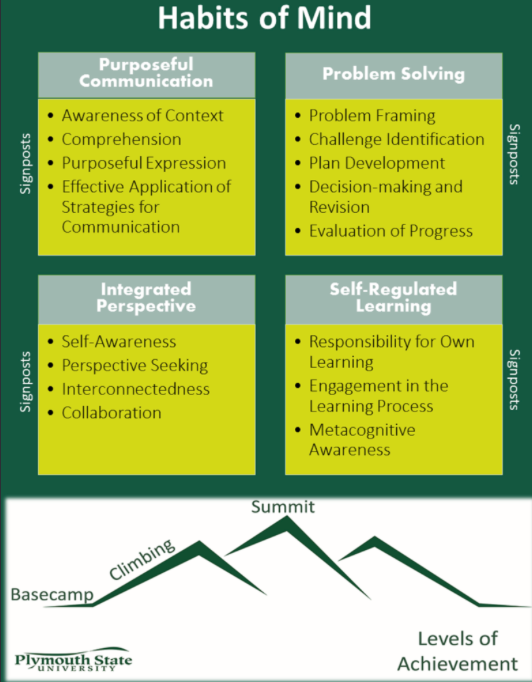
Now, what are the four HOBs? They are, “purposeful communication, integrated perspective, comprehension, purposeful expression, and effective application of strategies for communication” (“What Are the Habits of Mind?”). By the end of the semester, listed under the Plymouth TWP course description, with the Habits of Mind, students will be able to “identify, explore, and envision possible solutions for their problem, and their implications for the real world” (“Plymouth State”). Prior to starting university at PSU, I had no background knowledge/awareness of these terms and their importance.

To Agree vs. Disagree
No one can go through life without experiencing a challenge. It is the way we solve these challenges that makes a difference. While some problems are rather small, others are so big that they not only involve the individuals but the world around them.
Climate Change. A huge political issue that is still ongoing today. This was the title for the TWP course I had selected to take. Throughout a majority of this course, we worked together in small groups. Being able to work together on assignments and projects gives individuals the opportunity to not only collaborate/get to know their peers but also for us to “learn, see, and understand concepts, ideas, and real-world issues from the perspective of others” (“Habits of Mind Signposts”). This is an integrated perspective, the 3rd habit of mind. To establish IP, “one must recognize that their individual decisions impact the self, the community, and the environment”. However, individuals should “acknowledge the limitations in order to recognize the benefits of engaging with others in order to successfully collaborate” (“What Are the Habits of Mind?”). Speaking from personal experience, If there is no collaboration, the group will not work.
To illustrate, for our class final, we were separated into small groups to create a poster along with a research paper. This poster had to address our real world issue (climate change), with its “solution”. Then, during finals week, each group would present their project to the class.
There is no “I” in “team”
As a group, we had no issue listening to each members idea/perspective regarding the class TWP topic. It was the disagreements over the little things that made us not be able to come together nor connect with each other as a group.
To explain, instead of using the signpost perspective to create a cohesive poster that included everyone’s ideas and designs, the other 3 members wanted to each individually “take over” designing the poster. This failure to collaborate made the final not look cohesive, and unfortunately, our presentation ended up looking like 4 separate projects put together on a piece of poster paper.
Outside the classroom:
“Problem-solving encompasses a broad array of activities and approaches” (“What Are the Habits of Mind?”). Although this HOB could not save my final project, it has improved my technique while at the studio.

In order to execute a pirouette properly, one must spot, lift the body, and have a high relevé, all at once. If one out of the three does not occur, then the pirouette will fail. Speaking from personal experience, getting angry with yourself when a step goes wrong does not solve the problem. Now, I’m not saying do not get frustrated when a problem arises. That is almost impossible. Instead, when a problem occurs. Take a minute to pause and identify what went wrong. Then, see if it is fixable. This is “challenge identification; the first signpost (checkpoint) to problem-solving” (“Habits of Mind Signposts”). If the reasoning for why I fell out of my turn was because I had not been spotting. The next time I attempt the step, I will apply the attempted solution (spotting) in hopes of gaining the “desired outcome” (“Habits of Mind Signposts”).
When really focusing on my spot before and during the turn, has helped me stay up on relevé, which, in return, produced the pirouette.
Trying something new:
Self-regulated learning. “The ability to set personal goals for learning and the capacity to engage in a self-monitored learning process” (“What Are the Habits of Mind?”). One of thehardest transitions I had to adjust when starting university were my study habits.
The first psychology test I ever got handed back, at PSU I remember flipping my tests around and seeing a big red 50 marked on the front. I knew then that what I did in high school was not going to cut it at university I knew that if I did not improve my study skills now, I would be struggling not just in psychology, but in all my courses. Now, this was happening during the same time I was taking Tackling Wicked Problem. In attempt to no longer fail psychology, I used the SRL signposts to find out my “learning style”.
With the help of Metacognitive Awareness (3rd signpost for SRL), “the ability to identify one’s personal strengths and weaknesses as a learner” (“Habits of Mind Signposts”). I realized that by only writing the professors’ slide show notes was not helping me acquire nor memorize the material. After coming across multiple “study websites,” I finally found what I was looking for: Quiz-let. The best part about this. Quiz-let has zero cost! Using Quiz-let has not only helped me retain information for the test but has also enabled that knowledge to stay stored in my long-term memory. If it were not for the habits of mind, I might still be failing Intro to Psych.
Leave a Reply